
- Passing automated tests against a mock does not guarantee a connector works against the real product. Undocumented API changes can slip through untested.
- Getting real access to OEM environments, licenses, roles, data, and credentials is often harder than writing the connector itself, especially across a large portfolio.
- Mocks and fixtures are essential for speed and repeatability, but no simulated environment can capture every behavior of a continuously evolving product.
- Real product validation reveals what mocks cannot: auth restrictions, pagination edge cases, rate limits, undocumented errors, and schema drift.
- ConnectX Lab gives teams access to 1,230+ real and synthetic OEM environments for development, testing, UAT, and demos, without acquiring and maintaining every product themselves.
A connector can be built correctly, pass hundreds of automated tests, and still fail when it encounters the actual product it was designed to integrate with. The problem is not always the connector code.
Sometimes, the bigger challenge is access to the environment where that connector needs to work.
For teams supporting dozens or hundreds of third-party applications, getting access to every OEM product environment can be difficult. Licenses have to be arranged. Products need to be configured. Credentials and permissions need to be managed. Test data has to be prepared. Environments need ongoing maintenance.
Doing this for one integration may be manageable. Doing it across a large connector portfolio is a different problem.
As a result, engineering teams often depend on mocks, simulated API responses, and test fixtures to validate connector behavior. These tools are essential for fast and repeatable testing, but they cannot always reproduce what happens inside the actual product. That gap can remain invisible until the connector reaches production.
The environment your connector never tested against
Consider a connector built for a security platform. The engineering team has documented the API behavior, created test fixtures, written automated tests, and validated the expected request and response patterns. Hundreds of tests pass, and the connector is shipped.
Three weeks later, a customer reports that some authentication events are no longer appearing in their SIEM. The connector is still running. There are no obvious crashes. Health checks are passing. The issue was due to a change in the structure of one response field that was not available in the documentation used while developing the connector.
"actor": "svc-backup@corp.example""actor": {
"user": "svc-backup@corp.example",
"id": "a91f2c4e-..."
}The connector expected a string but received an object. The parser could not handle the new structure, and the affected event was dropped. The automated test suite still passed.
Why? Because the test environment was still returning the old response. The connector had been validated against a representation of the product, not the product itself.
The real challenge is getting access
This is where connector engineering becomes more than a coding problem. To validate a connector against a real OEM product, an engineering team may need:
Access to the right product edition
Valid licenses or NFR access
Correct user roles and permissions
Configured APIs and authentication
Realistic test data
Environment configuration and setup
Credentials that can be securely managed
Ongoing maintenance as the product changes
Now multiply that across 20, 50, or 100+ integrations. The challenge quickly shifts from “Can we test this connector?” to “How do we get access to the products we need to test it against?”
This is particularly difficult for enterprise applications where environments are expensive, restricted, complicated to configure, or typically available only inside a customer’s infrastructure. That is why teams often fall back on simulated environments.
Why mocks cannot represent the entire product
Mocks and test fixtures are not the problem. They are an important part of a scalable engineering workflow. They provide speed, repeatability, and control. But a simulated response only behaves according to what the team has defined. A real product can introduce conditions that were never included in the fixture.
The issue is not that automated testing is insufficient. It is that no simulated environment can guarantee that it represents every behavior of a continuously evolving third-party product. Real product access adds a different layer of confidence.
340 / 340 tests pass
Event silently dropped
Where mocks and real products diverge
| Area | What a mock can simulate | What a real product can reveal |
|---|---|---|
| Authentication | Expected credentials and tokens | Role restrictions, scopes, expired credentials, permission differences |
| Pagination | Predictable pages and responses | Large datasets, skipped records, duplicates, unexpected pagination behavior |
| Rate limits | Successful requests | Throttling under realistic request volumes |
| Errors | Predefined error responses | Undocumented errors, different status codes, unexpected formats |
| Schema behavior | A defined response structure | Added, removed, renamed, or differently typed fields |
Real product instances change the validation equation
Imagine being able to develop and validate a connector against the actual OEM product environment instead of recreating that environment internally.
Engineers can test the connector against real APIs, authentication flows, permissions, product configurations, data structures, and product behavior. They can discover problems that would otherwise appear only after deployment.
But there is another challenge: real environments are not always practical for every testing scenario.
Production data may be sensitive. Creating large datasets manually can take time. Teams may need repeatable environments for development, UAT, demos, or specific test cases. This is where having both live and virtual sandbox options becomes valuable.
What ConnectX Lab provides
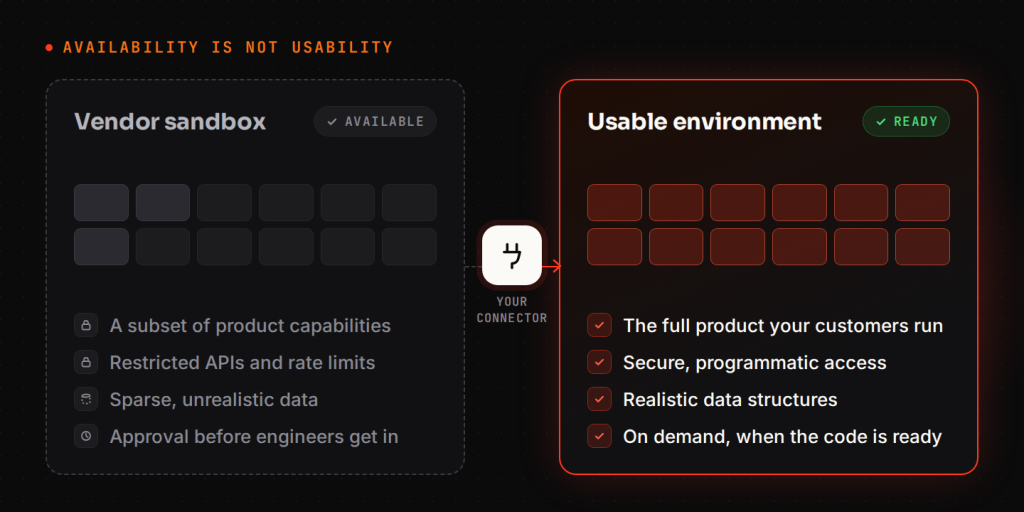
ConnectX Lab provides access to 1,230+ enterprise-grade OEM environments for connector development, testing, UAT, demos, and validation.
Instead of asking engineering teams to acquire and maintain every product environment themselves, Lab provides access to environments through Sacumen’s OEM and product partnership network.
Teams can work with live sandboxes and real product instances when they need to validate actual product behavior. For scenarios where real data is not practical, virtual sandboxes powered by AI-generated synthetic data can provide realistic datasets and test conditions without exposing production data.
The objective is not to replace automated tests or mocks. It is to add real product validation where simulated environments have limitations.
Proven at scale
The same discipline behind ConnectX Lab shows up across Sacumen’s connector portfolio.
Frequently asked questions
Why does a connector fail in production even after passing every test?
Because automated tests usually validate a connector against a mock or test fixture that represents expected API behavior, not the live product. If the real product changes — a new field type, an undocumented error, a stricter permission — the mock keeps returning what it was told to, tests keep passing, and the mismatch only surfaces once the connector meets the actual environment.
Why does a connector fail in production even after passing every test?
Because automated tests usually validate a connector against a mock or test fixture that represents expected API behavior, not the live product. If the real product changes, such as a new field type, an undocumented error, or a stricter permission, the mock keeps returning what it was told to. Tests keep passing, and the mismatch only surfaces once the connector meets the actual environment.
What is the difference between testing against a mock and testing against a real product?
A mock simulates a defined and predictable version of an API. A real product can introduce authentication requirements, pagination behavior, rate limits, schema changes, product-specific responses, and other real-world conditions that a mock may not fully represent. Testing against real product environments helps validate how a connector behaves under those actual conditions.
Why not just get direct access to every OEM product?
For a single integration, arranging access to an OEM product may be manageable. At scale, supporting dozens or hundreds of integrations can require licenses, environment configuration, credentials and permissions, test data, and ongoing environment maintenance. Managing that access across multiple products can become a significant operational and engineering effort.
What is ConnectX Lab?
ConnectX Lab provides on-demand access to a growing library of 1,230+ enterprise-grade OEM environments for connector development, testing, UAT, demos, and validation. It includes two types of lab environments: real product sandboxes through OEM/product partnerships and synthetic labs powered by AI-generated, schema-conformant data. This gives integration teams access to realistic product environments without having to independently provision and maintain every environment themselves.