
- Home
- Blog
- From Vision to Venture: Nitesh Sinha’s 11-Year Journey of Building Sacumen as a First-Generation Entrepreneur
From Vision to Venture: Nitesh Sinha’s 11-Year Journey of Building Sacumen as a First-Generation Entrepreneur
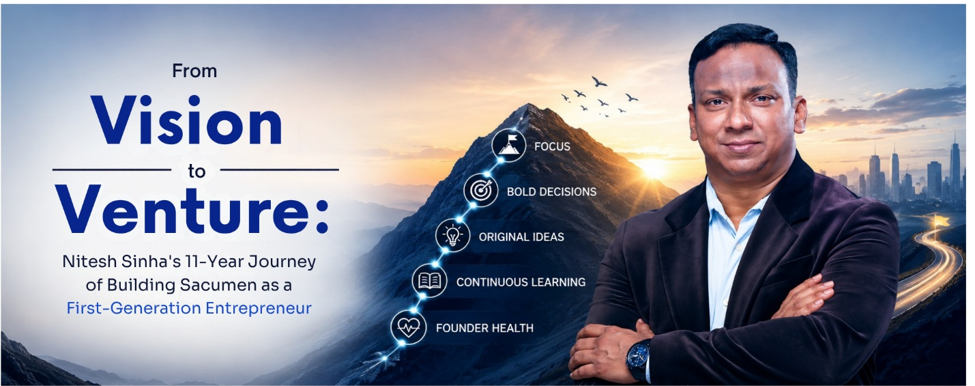
Building a company from scratch teaches you things that no business school can fully prepare you for.
You learn that not every opportunity deserves a yes. That focus is not about doing less but about becoming exceptionally good at something. That a genuinely original idea is often harder to find than it is to execute. That learning cannot stop just because the company has started working. And, eventually, that the health of the person making the decisions is not separate from the health of the business.
For Nitesh Sinha, Founder and CEO of Sacumen, eleven years of entrepreneurship have been shaped by these lessons.
There was no inherited business, established playbook or family enterprise waiting to be continued. Sacumen had to be built every bricks of decision chosen carefully at a time.
Looking back, the most important lessons are not about the milestones. They are about the choices behind them.
- Focus: Don’t Spray and Pray
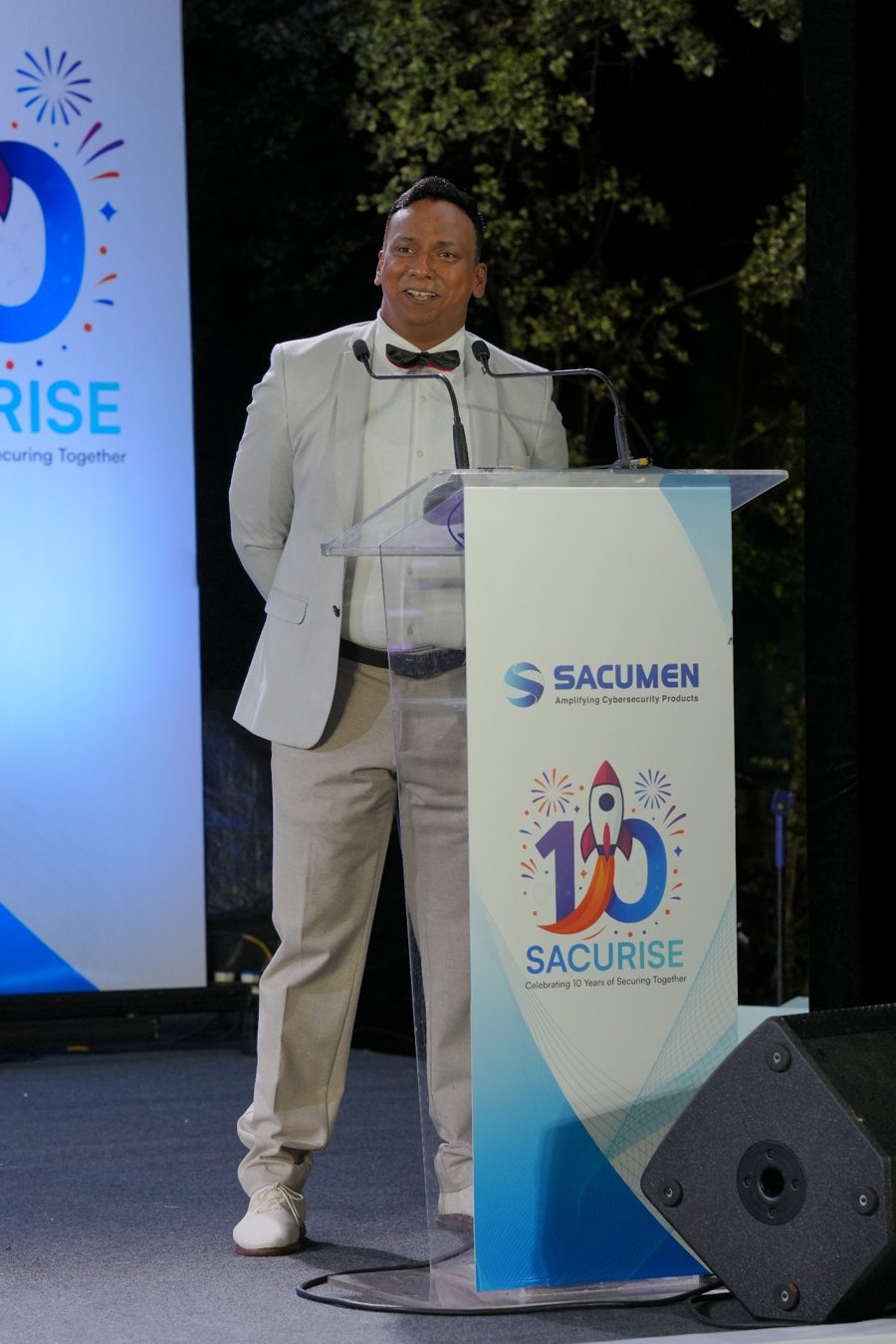
Early-stage companies are surrounded by possibilities. Every customer request can look like a new market. Every new problem can seem like an opportunity to expand. Every large deal can make a founder question whether staying focused is still the right strategy.
The temptation is understandable. When you are building from scratch, you do not want to close doors. But keeping every door open can leave you standing in the hallway. One of the most important lessons in Nitesh’s journey has been the value of choosing where not to compete.
Sacumen could have remained a broad technology services company, responding to whatever problem came through the door. Instead, the company increasingly focused its expertise on a specific and often overlooked problem: connectors.
That focus created depth. Years of working on connectors meant understanding not just how to build them, but what happens after they are built. APIs change. Schemas evolve. Authentication breaks. Integrations behave differently across environments. A connector that works during development can behave very differently once it reaches production.
The more Sacumen worked on these problems, the clearer the opportunity became. Focus was no longer about limiting what the company could do. It was about building knowledge that would be difficult for a generalist to replicate. That is the difference between being busy and building an advantage. A company does not become known for everything it is willing to do. It becomes known for something it has chosen to understand better than most.
- Saying No Is Harder Than Saying Yes
Saying yes feels like progress. A new customer is progress. A new project is progress. A new revenue opportunity is progress. Saying no can feel like the opposite. But founders eventually discover that every yes creates an obligation. It consumes engineering capacity, leadership attention, time and sometimes the strategic flexibility to pursue something more important later.
For Nitesh, learning to say no was not about becoming less ambitious. It was about becoming more deliberate. The question changed from:
“Can we do this?” to: “Should this be something we build our future around?”
That is a much harder question. A company can technically take on almost any project if it has enough people and enough time. The harder decision is determining whether the project strengthens what the company wants to become.
This becomes even more important as a company grows. Early on, saying yes may help you survive. Later, saying yes indiscriminately can prevent you from scaling with purpose. The ability to reject an attractive opportunity because it does not fit the larger direction is one of the less visible disciplines behind sustainable growth.
For a first-generation entrepreneur, this discipline has to be developed through experience. There is no inherited rulebook telling you which opportunities matter five years from now. You learn by making the calls, living with them and becoming better at the next one.
- An Original Idea Is Hard. Executing It Is Easier.
There is a popular belief in entrepreneurship that ideas are cheap and execution is everything. Nitesh sees the problem differently.
Execution is difficult, but execution can be built into a process. You can hire people, create teams, establish systems, introduce tools and improve the way work gets done.
The harder part is identifying an idea that is both original and useful.
That is especially true today, when AI can dramatically reduce the time between an idea and a working prototype. AI can write code. It can generate variations. It can help test concepts. It can accelerate development.
What it cannot easily do is decide which problem is worth solving in the first place. That decision still requires observation, experience and judgment.
Sacumen’s journey is rooted in that kind of thinking. The company did not invent the need for software connectors. Connectors already existed. The opportunity was in recognizing that the way they were built, tested, deployed and maintained could become a discipline of its own. That original thought mattered.
Once the direction was clear, execution could follow. This distinction becomes even more important in the age of AI. When the cost of building software continues to fall, the advantage shifts toward the quality of the problem being solved.
When everyone can build faster, knowing what to build becomes more valuable. The future may belong less to the company that can execute an idea fastest and more to the company that can identify the right idea before everyone else sees it.
- Learning Never Stops
There is a point in every founder’s journey when experience can become a trap. You have built the company. You know the market. You have seen enough cycles to recognize patterns. It becomes easy to rely on what you already know.
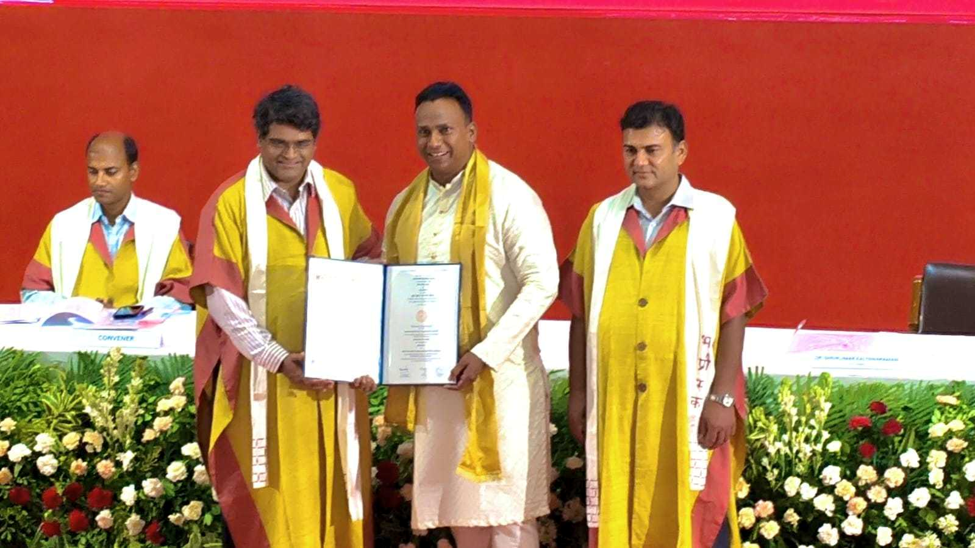
Nitesh has taken a different approach. For him, learning has never been limited to what the business demands today. It has meant deliberately preparing for what the business may need tomorrow. That is reflected in the choices he has made alongside building Sacumen. He completed a Master’s degree in Artificial Intelligence and Machine Learning from the Indian Institute of Technology Kanpur, pursued the Advanced Management Program at IIM Bangalore, and completed a Post Graduate Certificate in Product Management.
These are not credentials collected after the fact. They reflect a broader approach to leadership: stay close to technology, understand how businesses evolve, and keep developing the ability to turn technical possibilities into products that solve real problems.
The timing of his AI and ML education is particularly telling. AI is now reshaping how software is built, tested and operated, but the important question for a technology leader is not simply whether to adopt AI. It is understanding where AI can create meaningful advantage and where human judgment still matters most. That thinking is increasingly visible in Sacumen’s evolution, including its use of AI across connector development, testing and lifecycle management.
But continuous learning is not just about earning another qualification or keeping up with the latest technology. It is about remaining willing to question what you already know. What has changed since we last looked at this problem? What are customers struggling with now that they were not struggling with five years ago? What assumptions worked at one stage of the company but no longer hold true? Those questions become more important as a company grows.
For a founder, learning is not something that happens before leadership begins. It is part of leadership itself. Eleven years into building Sacumen, Nitesh continues to treat learning not as a milestone to complete, but as a discipline to maintain.
- Health Is a Founder Decision, Not Just a Personal One
Entrepreneurship often rewards endurance. Long days are accepted as part of the job. Personal priorities get postponed. Health can become something to address after the next milestone, the next customer, the next quarter.
The problem is that there is always another milestone. Over time, Nitesh came to see health differently. A founder’s physical and mental energy affects how they think, decide and lead. That makes health more than a personal matter. It becomes part of the company’s ability to function.
The same principle applies to employees.
Sacumen is a technology based company. Its work depends on people solving difficult problems, making good decisions and staying creative under pressure. That requires more than technical capability. It requires people to have the energy and wellbeing to use that capability effectively.
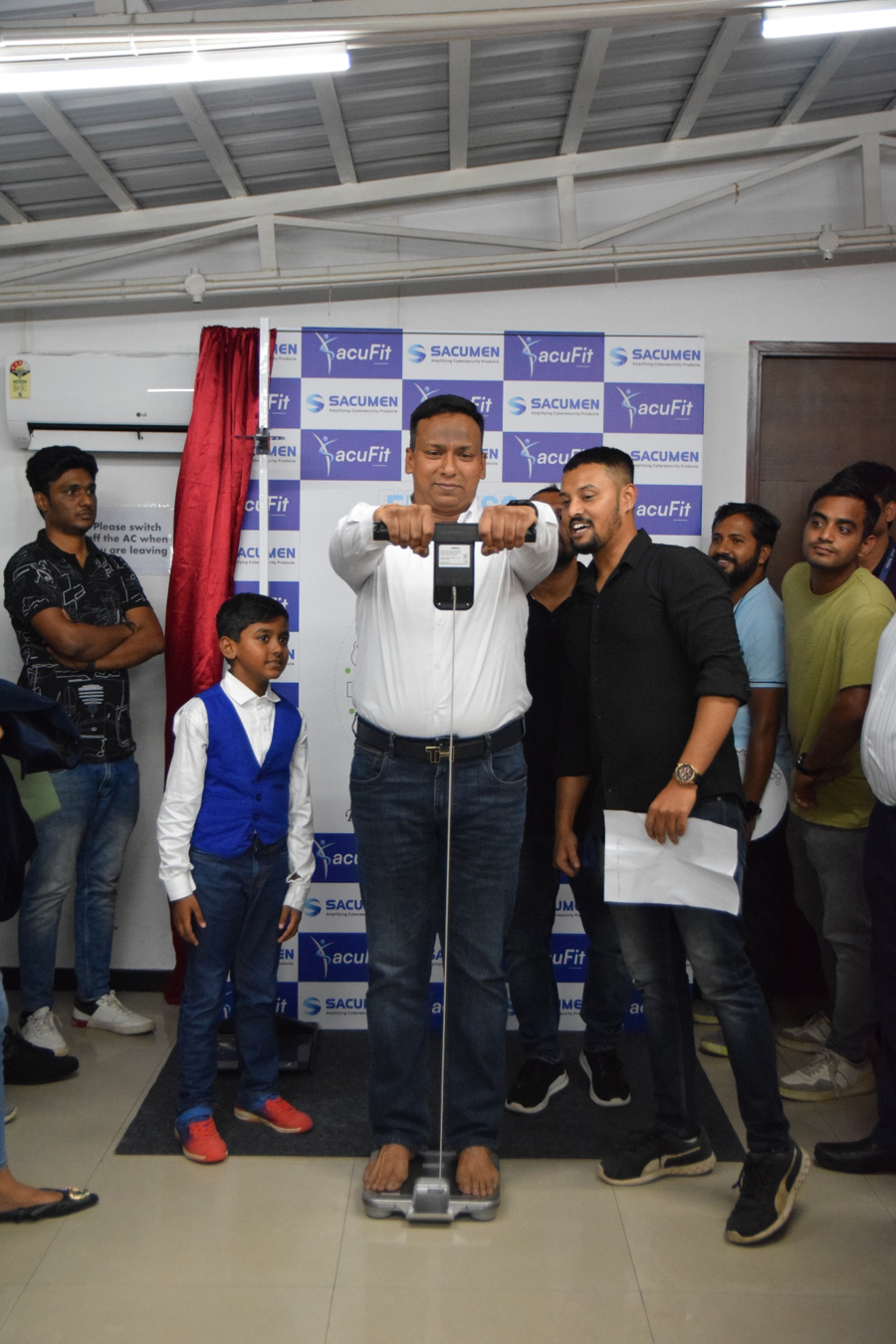
This thinking contributed to Sacufit, Sacumen’s employee wellness initiative. The larger lesson is simple: a company cannot build sustainable performance by treating people as if their capacity is unlimited. Taking care of people is not separate from building a high-performing organization. It is part of it. For a founder, that realization can be difficult because the instinct is often to put the business first.
But a company is not an entity that exists independently of its people.
It is built by them.
Eleven Years, Five Lessons, One Direction
Eleven years have taught Nitesh Sinha that building a company is less about having a perfect playbook and more about making the right choices, staying focused, continuing to learn, and building sustainably.
Those lessons continue to shape Sacumen’s next chapter: building a safer world through innovative products and integrations, with a clear mission to make ConnectX the default Connector Lifecycle Management (CLM) solution for software product companies.
The journey that started with a vision now has a clear direction. And there is much more to build.
Other Blogs