We’ve spent the better part of a decade making connector development faster. We automated testing. We introduced low-code platforms. Now generative AI can produce integration logic in seconds. And yet, when integration portfolios scale from 20 connectors to 100 or 200, roadmaps still slip.
When an enterprise integration request grows to that scale, the default playbook is predictable: add engineering capacity, hire more developers, adopt better frameworks, automate test execution.
Until integration leaders recognize external system access as engineering infrastructure, not an administrative task, hiring more developers won’t increase integration capacity. It will only create a bigger queue of engineers waiting to build.
1. The Code Is Rarely the Whole Problem
The connector does not become production-ready because an engineer finished writing the syntax. It becomes production-ready when the engineering team can confidently answer a far more unforgiving question: does this connector actually behave as expected when wired into the real system?
That answer cannot come from code alone. It requires access to a functional target environment with the conditions needed to validate the integration:
- The right credentials and authentication scope
- Active API versions and endpoint access
- Representative, schema-conformant payloads and realistic data
- The ability to trigger and validate relevant workflows
- Dedicated, repeatable access for validation as the connector evolves
Without these conditions met, your team is not validating software; they are developing against assumptions. And in complex enterprise systems, assumptions are the single most expensive dependency in integration engineering.
2. A Sandbox Is Not the Same as Usable Access
There is a common executive misconception that goes: “The vendor has a developer sandbox, so testing is handled.”
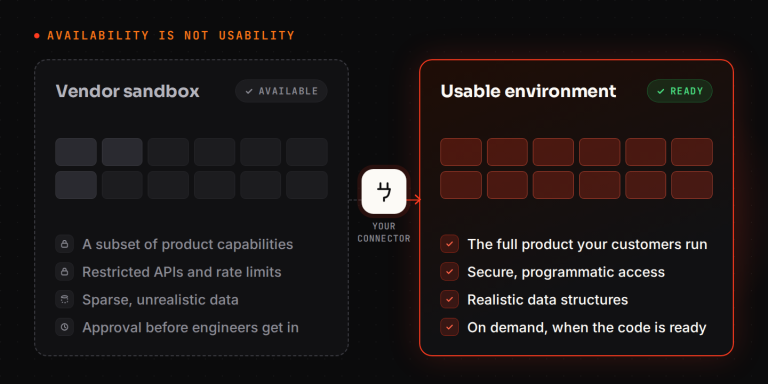
Availability is not usability. Depending on the vendor and product, a sandbox may expose only a subset of product capabilities, restrict certain APIs, enforce rate limits, lack realistic data structures, or require additional approval before engineers can access it.
The more important question is: does the vendor environment give our developers secure, programmatic access to a realistic system when the code needs to be validated?
That distinction becomes increasingly important as integration portfolios grow.
3. The Dangerous Middle Ground Between Mocks and Reality
Mocks and stubs are essential development tools. They allow engineers to isolate unit logic, run local test suites, and simulate basic request-response cycles quickly.
The risk emerges when organizations confuse simulated behavior with validated behavior.
| Dimension | Mock-Based Testing | Real Environment Validation |
|---|---|---|
| System Behavior | Reflects internal assumptions of system behavior | Reveals actual vendor system responses |
| Edge Cases | Limited to pre-programmed scenarios | Exposes undocumented API quirks & payload mutations |
| Authentication | Hardcoded or bypassed tokens | Validates real authentication flows, token refreshes, & scopes |
| Risk Profile | High rate of post-launch production failures | High confidence pre-ship deployment |
A mock tells you what you think the external system will do. A live, high-fidelity environment tells you what it does. That distinction matters when dealing with authentication changes, schema mutations, rate limits, undocumented behaviors, and other conditions that are difficult to model completely.
4. The Hidden Tax of Environment Bottlenecks
Environment bottlenecks rarely appear as a line item on a project plan. They surface later as rework, delayed releases, and engineering friction.
An engineer builds against incomplete documentation or static mocks because the live environment isn’t available. Weeks later, when access is finally secured during UAT, real-world testing exposes issues. The connector returns to development, release dates move, and engineers lose context.
At one or two integrations, this is friction. At 100+, it becomes structural technical debt.
Every connector introduces another partner relationship, credential lifecycle, security review, and set of API assumptions. Without reliable environment access, the organization’s ability to generate code starts outpacing its ability to validate it.
The roadmap may say 100 connectors. The real constraint is whether the organization can validate 100 connectors with confidence.
The Paradigm Shift
Treat environments as infrastructure
An OEM testing environment should not be viewed as an external asset that a developer requests via a ticket when code is ready for QA. It must be treated as core software engineering infrastructure, no different than your CI/CD pipelines, cloud runtime environments, or observability stacks.
You do not ask permission to spin up a build container every time a developer opens a pull request. You build automated, repeatable infrastructure that makes containers available on demand. Integration environments deserve that exact same architectural approach:
- Instant provisioning — Developers get environment access in seconds, not weeks.
- Continuous availability — Environments remain accessible throughout the full software lifecycle.
- Data safety — Testing occurs against real-world schema behaviors without exposing sensitive production or customer data.
Validation is a lifecycle requirement, not a single event
The need for high-fidelity environments does not end once a connector passes UAT and ships to production.
External vendor APIs are living targets. SaaS platforms push silent updates, deprecate fields, alter rate limits, and modify payload structures without warning. Validating a connector once prior to initial release is insufficient for enterprise reliability.
You must be able to re-validate connector behavior continuously against live endpoints to catch API drift before it breaks downstream enterprise workflows.
For integration teams operating at scale, I believe environment access should be treated as a permanent requirement of the integration lifecycle—not because every change requires a full validation cycle, but because the ability to validate against the dependency needs to remain available throughout the connector’s lifecycle.
What Integration Leaders Must Evaluate
If you are assessing the maturity and true scalability of your organization, look beyond basic developer headcount and connector output. Ask your leadership team these operational questions:
Provisioning Lead Time
How many days or weeks elapse between an engineer requesting access to a target system and actually running code against it?
Coordination Overhead
How many emails, vendor approvals, and cross-team tickets are required to maintain sandbox credentials for your current connector catalog?
Environmental Fidelity
What percentage of your integration testing relies on static, hardcoded mocks versus live, schema-matched environments?
Data Privacy & Compliance
Are your teams forced to use real customer environments to run tests because adequate synthetic alternatives do not exist?
Lifecycle Ratio
What proportion of total engineering time is spent writing connector logic versus waiting on external dependencies and fixing environment-driven bugs?
The answers to these questions reveal your true integration maturity.
Why We Built ConnectX Lab
It was this exact structural realization that led us at Sacumen to build ConnectX Lab.
We didn’t want to build just another testing suite or mock generator. We wanted to remove environment access, environment preparation, and the uncertainty around test data from the critical path of integration delivery.
ConnectX Lab is designed to give engineering teams access to real OEM environments & synthetic labs across enterprise SaaS and on-premises products. But access to the environment is only part of the problem. For an integration team to properly validate a connector, the environment also needs to behave like the environment their customers work with.
That is where realistic test data generation becomes important.
Enterprise teams often need to populate an environment with data that reflects real operational scenarios before they can validate a connector. A security product, for example, may need realistic alerts, events, incidents, users, assets, or activity logs before an engineering team can properly test ingestion, workflows, mappings, enrichment, or outbound actions. Creating that data manually can become another bottleneck.
With ConnectX Lab, teams can generate the test data and logs needed to exercise realistic integration workflows, so the environment is not simply accessible, but ready to be used for development, validation, testing, UAT, demonstrations, and other stages of the integration lifecycle.
For sensitive environments where real system connections or production data introduce compliance and privacy concerns, synthetic virtual labs provide high-fidelity, schema-conformant behavior without exposing PII or live enterprise data. That distinction matters. || ! An accessible environment is useful. An accessible environment with realistic data and behavior is actionable.
The goal isn’t simply to make testing easier. It is to turn environments, test data, and the conditions required to validate integrations into an accessible, repeatable and programmatic utility across the product lifecycle.
The Future of Integration Velocity
As AI tools make code generation increasingly trivial, writing connector code will cease to be a competitive differentiator.
Making code faster does not inherently make integration delivery faster if the newly generated code spends weeks waiting for a live endpoint to prove itself. All we have done is shift the bottleneck further down the pipeline.
The future of integration scale won’t be defined solely by how quickly teams can generate code. It will belong to the organizations that give that code an immediate, secure, and reliable place to validate itself.