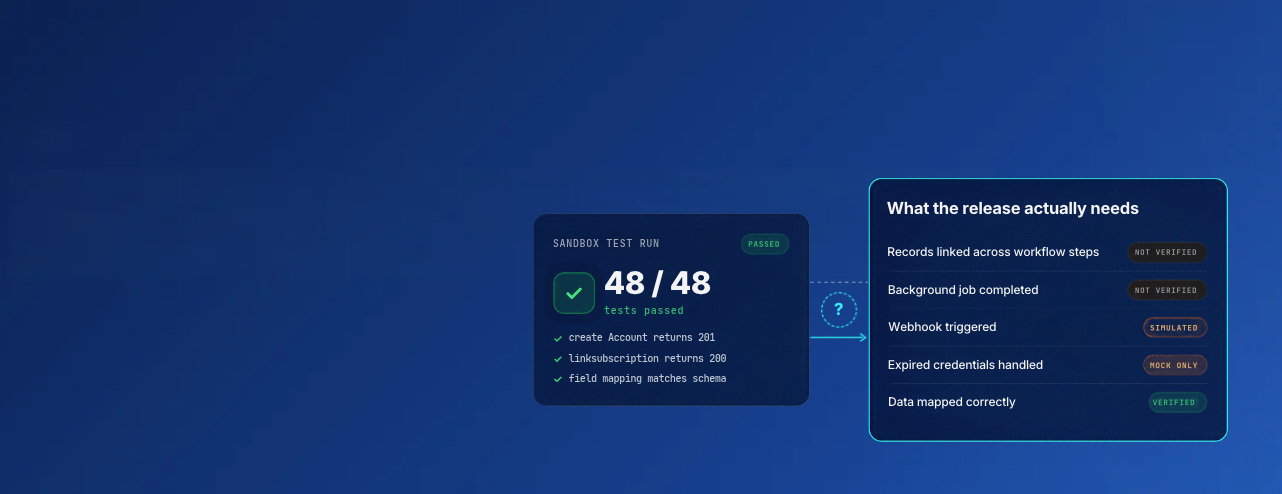

Your connector’s test run is green. The responses match expectations, the data maps correctly, and every test passes. But is the integration ready for release?
That depends on what the tests actually prove. A vendor sandbox provides an isolated environment for testing integrations, but its capabilities vary by product.
Here’s how to assess whether your sandbox provides meaningful validation.
1. Start With the Workflow, Not the Sandbox
Define what the connector must accomplish before you evaluate the environment. Consider a CRM-to-billing integration that creates customer accounts, links subscriptions, and synchronizes updates.
Individual API calls may work correctly while the complete workflow fails because records aren’t linked properly or a later step depends on data created earlier.
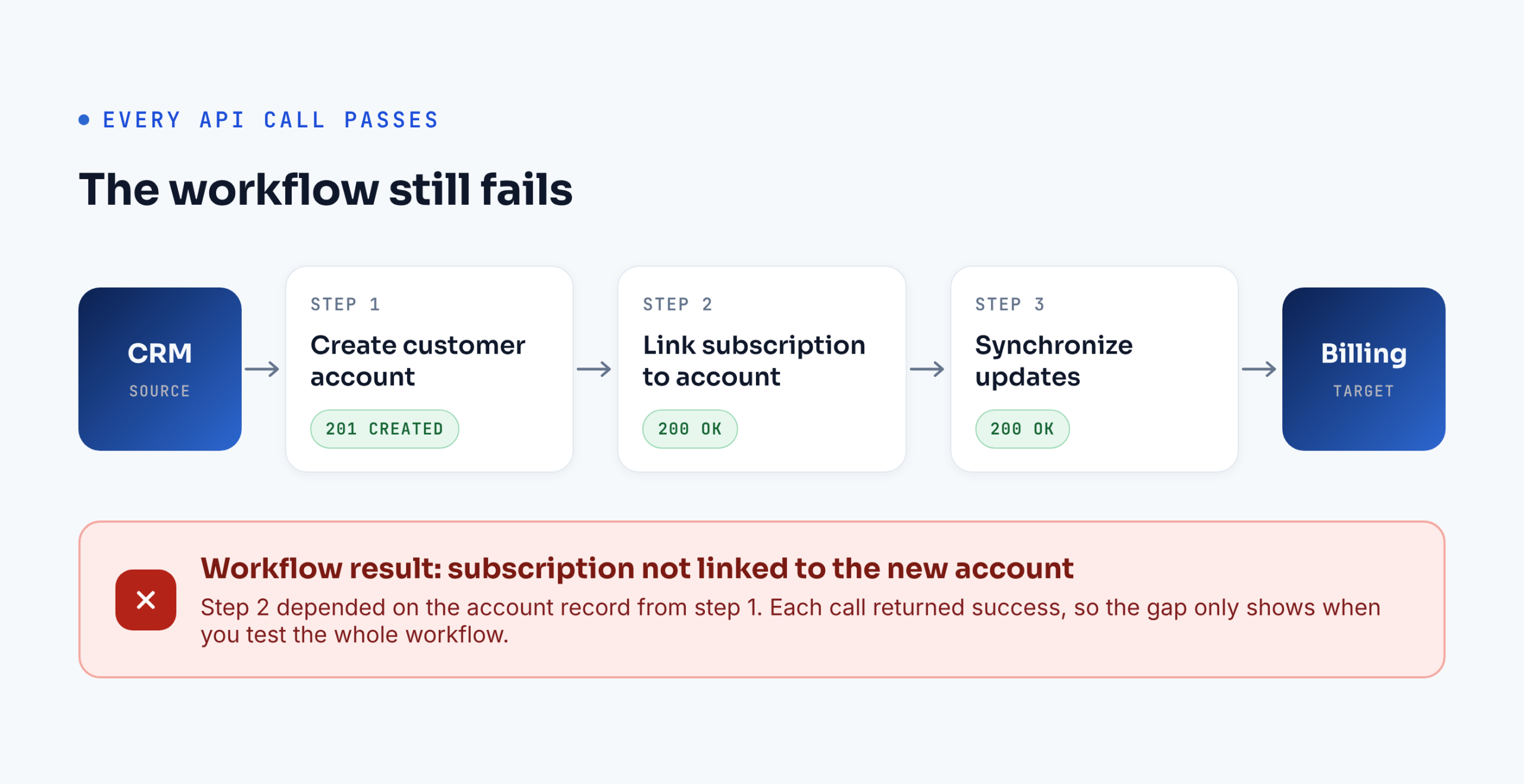
List the key tasks your connector must perform, including dependencies between steps. Then check whether the sandbox supports testing those workflows.
The depth of testing should reflect the connector’s purpose. An integration that retrieves information has different requirements from one that creates records or triggers actions in another system.
2. Understand What the Sandbox Actually Does
Some sandboxes execute operations against test data. Others return predefined responses or simulate selected scenarios.
For example, a sandbox might return a successful response to a record-creation request without creating a persistent record or triggering the follow-up actions available in the live product.
Check the vendor’s documentation to establish:
- Which API operations and features are supported.
- Whether requests change test data or return simulated responses.
- Whether required events and webhooks can be triggered.
- Whether asynchronous operations can be tested.
- Which behaviors differ from the live product.
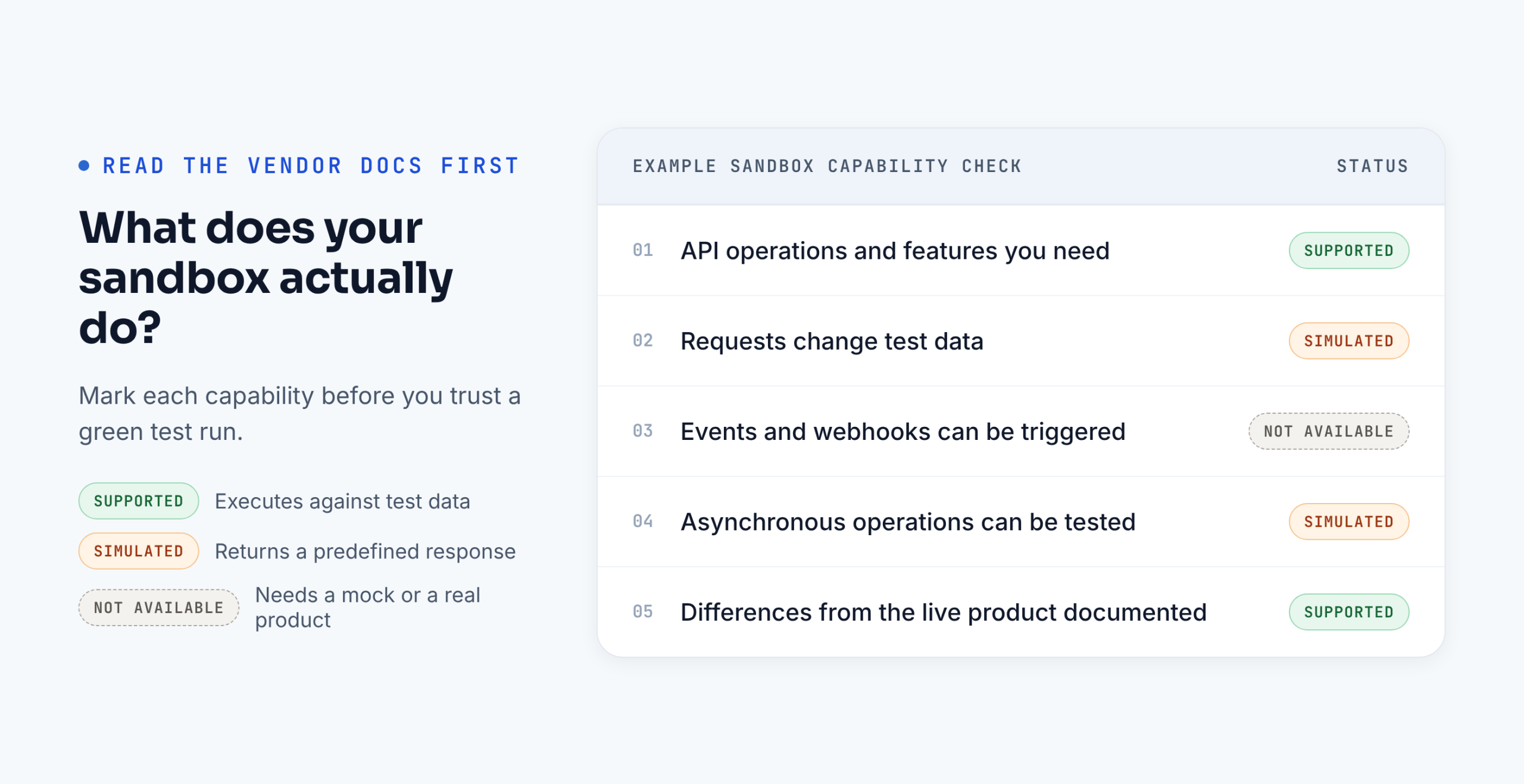
These details determine what your tests can reliably demonstrate.
The sandbox may also differ from production in API versions, authentication rules, validation requirements, or performance limits. These differences can cause a connector that passes sandbox tests to fail in production.
Document known differences and identify which release-critical behaviors remain unverified. Test supported scenarios in the sandbox, use mocks where appropriate to check specific error-handling logic, and determine whether access to a real product environment is necessary to verify behavior the sandbox cannot reproduce.
3. Test Realistic Data Conditions
A few records with every field populated may be enough to verify basic data mapping. They won’t reveal how the connector handles missing information, related records, status changes, or large datasets.
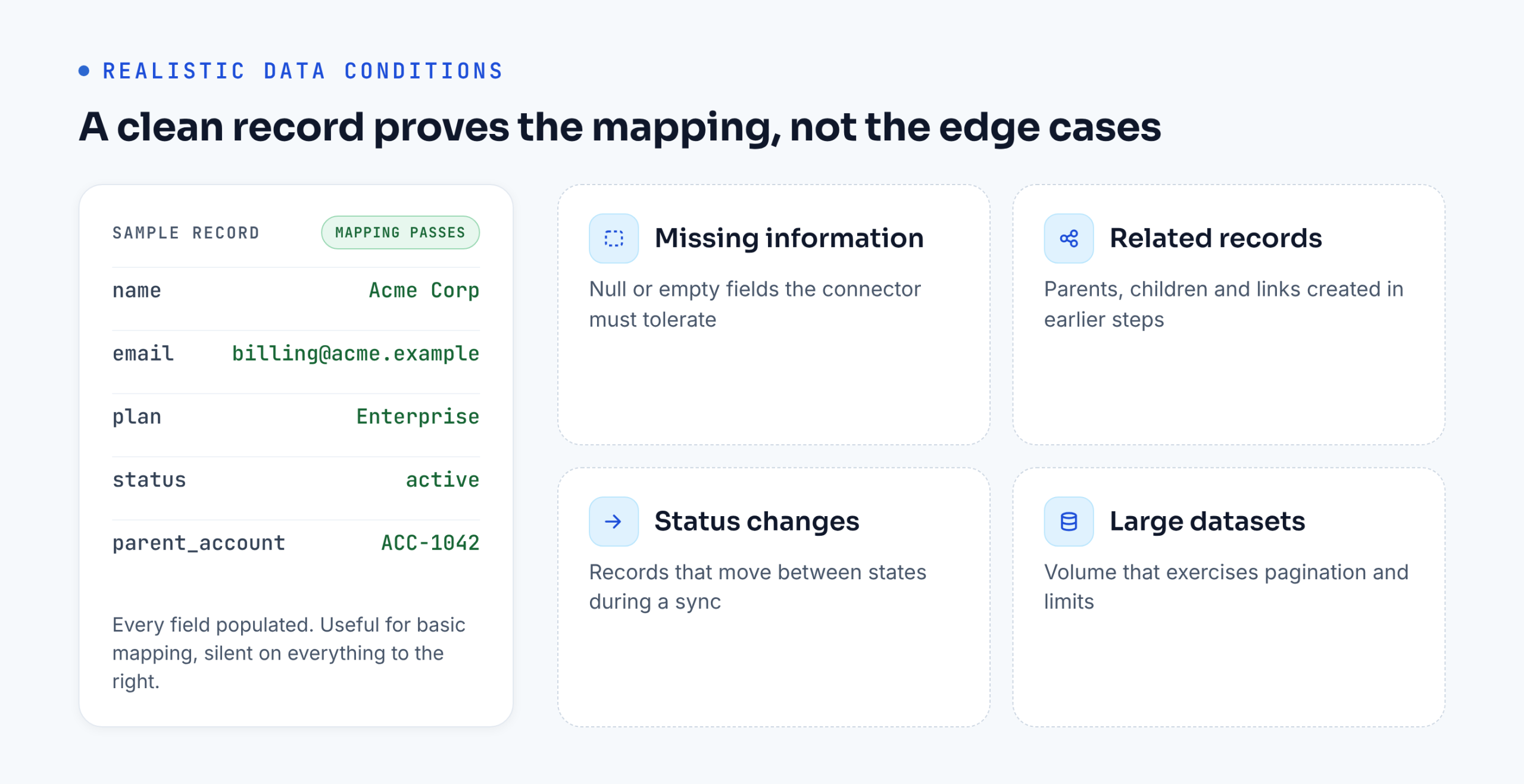
Identify the data conditions that could affect each workflow and test them where the environment allows.
Remember that realistic test data and realistic product behavior are different. Data that follows the correct structure helps validate data handling but doesn’t prove that the sandbox reproduces the live product’s behavior.
For more controlled data testing, synthetic data can help cover different record structures and conditions without exposing real customer data. However, it cannot independently verify how the live product processes those records.
4. Verify Outcomes, Not Just Responses
A successful API response doesn’t always mean the requested operation has finished.
For example, an API might accept a request to create an incident and return an identifier while processing continues in the background.
Check the API’s documented behavior and verify the result using a supported method, such as retrieving the record, checking its status, or receiving a completion notification. A sound validation process checks three things:
Request Correctness
The connector sends the intended operation and parameters.
Response Handling
The connector interprets the returned status and data correctly.
Outcome Verification
The expected state exists afterward, confirmed by a read, a status check, a poll or a webhook.
Outcome verification matters most for connectors that create, update or trigger actions. If the sandbox only simulates the response, record that.
5. Test How the Connector Handles Failures
Connectors also need to handle expired credentials, insufficient permissions, rate limits, and temporary service errors.
Some sandboxes can reproduce these conditions. Others require mocks, which simulate specific API responses.
Mocks help verify how the connector handles an error, but they don’t establish how the actual product produces it. If a required scenario cannot be tested against the product, document the method used and the evidence it provides.
6. Turn Limitations into Release Criteria
The sandbox limitation doesn’t automatically block release. What matters is whether it prevents you from verifying a required behavior.
Use a simple validation record to help reviewers assess the evidence.
| Validation Item | What to Record |
|---|---|
| Requirement | What the connector must do |
| Test Scenario | Steps and expected result |
| Environment | The sandbox, mock or other setup used |
| Evidence | The observed result and how it was verified |
| Limitation | Any behavior the environment could not reproduce |
| Release Decision | Satisfied, or needs further testing |
This makes it easier to identify unresolved risks and determine whether additional testing is necessary.
Make the Evidence Count
A passing test matters when you know what it proves. Test the workflows your connector must support, understand the sandbox’s limitations, and verify outcomes wherever possible.
When a critical requirement remains unverified, determine whether another testing method or a suitable product environment can provide the missing evidence.
Before approving your next connector, ask:
Struggling with environment access, connector development, testing or validation? Talk to Sacumen about how we can help.
Frequently Asked Questions
1. How do I document sandbox limitations for a release review?
Use a validation record with one row per requirement: the scenario, the environment used, the observed evidence, any behavior the environment couldn’t reproduce, and the release decision. Reviewers can then see which requirements are proven and which are accepted risks.
2. How do I confirm that an asynchronous operation actually completed?
Check the API’s documented completion mechanism: a status endpoint, a polling pattern, or a webhook callback. An accepted response alone shows the request was received, not that the work finished.
3. What is the difference between response handling and outcome verification?
Response handling checks that the connector interprets what the API returned. Outcome verification checks that the expected state or business result exists afterward, through a read, a status check, or another supported mechanism. A connector can pass the first and fail the second.
4. Which connectors need deeper validation?
Connectors that create records, update data or trigger actions carry more risk than read-only collection, because errors change state in an external system. Deeper validation should cover side effects, retries and failure handling for those.
5. Should I mark a scenario as validated if I tested it with a mock?
Mark it as validated at the level the evidence supports. A mock shows how your connector handles a defined condition. It doesn’t show how the vendor product produces that condition. Record the method so reviewers can tell the difference.