
How to Catch a Broken Connector Before Your Customer Does
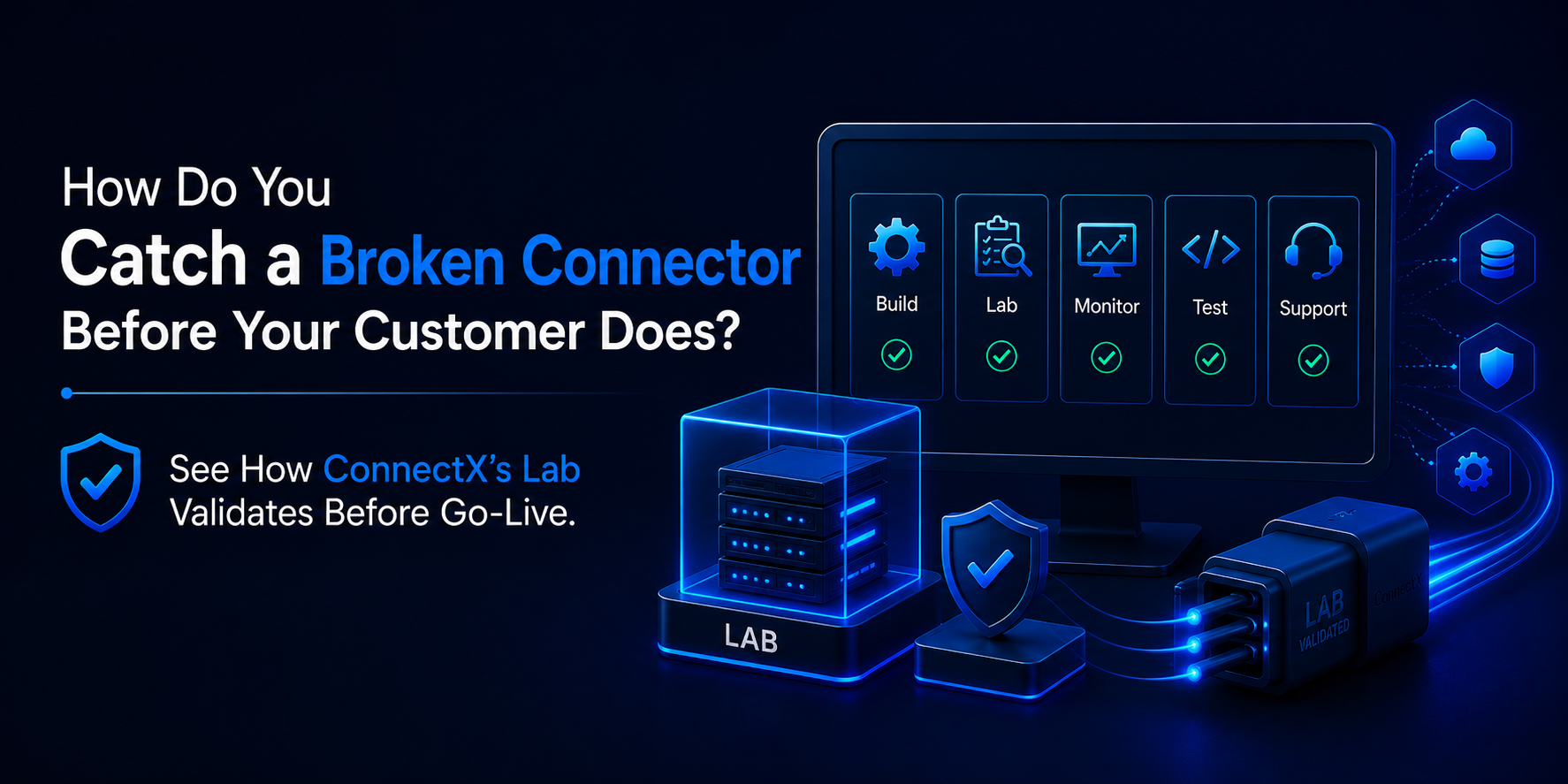
A connector that passes every internal test can still fail in production. The reason isn’t bad engineering – it’s where the testing stops. Here’s how pre-production OEM validation closes the gap.
Key takeaways
- Most connectors are validated in dev environments that don’t reflect live OEM behavior, so failures surface in production instead of QA.
- The breaks come from API version drift, authentication differences, and edge-case payloads at scale – none of which appear against mocks.
- Testing against real OEM environments before go-live catches the majority of failures pre-production and cuts UAT time significantly.
- One AI SOC platform vendor used this approach to ship a full quarter of integrations with zero production failures.
The problem: you find out when the customer does
A connector clears every internal test, ships on schedule, and breaks in production three weeks later. Not in your environment. At the customer’s site, on their data, in front of their technical team.
It happens constantly, and it almost never happens because the engineering was bad. It happens because the testing stopped one step short of where the risk actually lives.
For software product companies shipping integrations under release pressure, this is the failure mode that quietly erodes trust: the customer becomes your QA team, and every miss becomes an escalation.
Where most connector testing stops
Most teams test connectors in a development environment. They mock the OEM API, feed it clean sample payloads, confirm the happy path works, and call it validated.
The problem is that a dev environment is not a production OEM environment, and the gap between the two is exactly where connectors fail. Mocked responses don’t drift. Sample payloads don’t carry the malformed fields a real tenant generates at 2 a.m. Auth flows that pass against a stub behave differently against a live identity provider under load.
So the failure isn’t caught by QA. It’s caught by the customer. By the time it surfaces, it’s not a bug anymore – it’s a rollback, an escalation, and a hit to the trust you spent months earning.
What actually breaks between dev and production
The drift between a clean dev test and a live deployment is rarely one big thing. It’s a stack of small ones.
API version drift
OEMs ship three to five API versions a year, and not all of them announce breaking changes. A field gets renamed, a response structure changes shape, a deprecated endpoint goes quiet. Your connector was correct the day you built it and silently wrong the day the OEM pushed an update.
Authentication and token behavior
Token lifetimes, refresh behavior, and scope handling often differ between a sandbox credential and a production one. A flow that authenticates cleanly in testing can stall the first time it hits a real tenant’s identity configuration.
Data at scale
Field mappings that look correct against ten sample records behave differently across tens of thousands. Edge-case payloads, null fields, unexpected encodings, and event types you didn’t anticipate only show up when real data moves through the connector at volume.
None of these are visible in a dev environment. All of them are visible in a production one. The question is whether you see them first, or your customer does.
The fix: validate against real OEM environments before go-live
The way to close the gap is to test the connector where the risk lives – against real OEM behavior- before release rather than after. ConnectX’s Lab provides two ways to do that.
Live OEM Sandbox. A real OEM environment through ConnectX’s partner network, valid for 30 to 90 days. You validate the connector against the actual platform it will run against in production, including the auth flows and API behavior you can’t replicate with a mock.
Virtual Sandbox. Synthetic datasets across every event type, served from a containerised environment with REST stubs. It’s built to surface the malformed payloads, edge cases, and volume conditions internal QA typically misses.
In both, the connector runs the full path it would run in production: live API calls against the current OEM version, real authentication and token refresh, and high-volume payloads including the null fields, malformed records, and unexpected event types QA scripts rarely cover. The failure modes that normally surface in a customer’s environment are forced to surface in the lab instead, backed by more than 1,080 lab-validated OEM environments.
See How ConnectX’s Lab Validates Before Go-Live.
What pre-production validation catches: a real example
One AI SOC platform vendor was discovering connector failures the same way most teams do: when their customers reported them. They had a quarter of integrations to ship, no access to live OEM environments before go-live, and internal QA that caught less than half the failures.
After running every connector through ConnectX’s Lab, the results changed measurably:
| Metric | Result |
| Integration failures caught pre-production | 90%+ |
| UAT cycle time | Cut by 50% (3-4 weeks to under 2 weeks per connector) |
| Rollback risk | Reduced 60% |
| Rework effort | Reduced ~40% |
| Production failures | Zero |
“My best engineers were stuck firefighting failed connectors. Now they’re shipping new ones.”
– VP of Product Integrations, a leading AI SOC platform
The number that matters most isn’t in the table. It’s the one that didn’t happen: zero production failures across the integrations they shipped.
The bottom line
Dev testing ends where production risk begins. That’s not a process flaw you can fix by testing harder in the same environment – the environment itself is the limitation. As long as you validate connectors against mocks, your customers will keep being the ones who find what you missed.
Pre-production OEM validation moves that testing to where the risk actually lives, so failures surface in the Lab instead of in a customer’s production system. And when validation surfaces something that needs more than a fix – an edge case, a custom connector, a build your team doesn’t have bandwidth for – Sacumen’s product engineering team builds and certifies it.
Frequently asked questions
What is pre-production connector testing?
It’s validating an integration against real OEM environments and production-like conditions before release, rather than relying only on dev-environment tests against mocked APIs.
Why do connectors that pass QA still fail in production?
Because dev environments don’t reflect live OEM behavior – API version drift, real authentication flows, and edge-case data at scale only appear in production conditions.
What’s the difference between a Live OEM Sandbox and a Virtual Sandbox?
A Live OEM Sandbox is a real OEM environment via partner network (30-90 day validity). A Virtual Sandbox uses synthetic datasets and REST stubs in a containerised environment to stress-test edge cases and volume.
Stop finding connector failures in production.
Book a 30-minute lab walkthrough at sacumen.com/connectx
Other Blogs