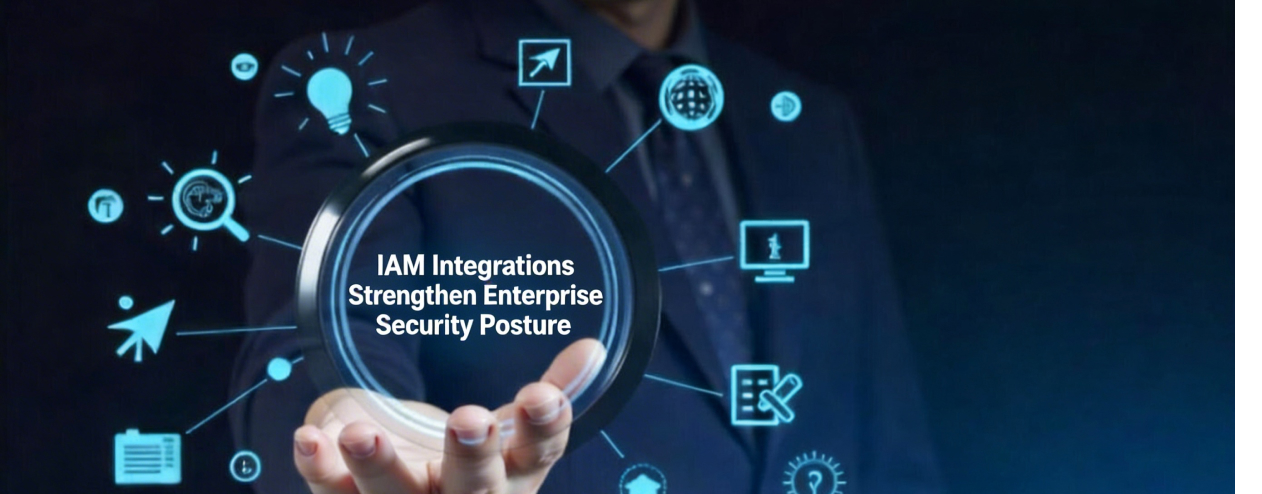
How IAM Platform Integrations Strengthen Enterprise Security Posture?
The modern enterprise faces an increasingly complex and aggressive threat landscape, where cyberattacks target not only systems but also the very identities that access them. In this environment, Identity and Access Management (IAM) platforms have evolved beyond basic authentication tools—they now play a critical role in unifying and strengthening enterprise security posture. The true potential of IAM is unlocked when integrated with other security technologies, such as Security Information and Event Management (SIEM), Data Loss Prevention (DLP), Endpoint Detection and Response (EDR), and more. This blog explores how these integrations create a coordinated defense framework, delivering better visibility, faster response times, and stronger protection against both external and insider threats.
Why Integrated IAM Solutions Are Now a Security Imperative?
Enterprises can no longer afford to treat IAM platforms as isolated systems managing only user access. Cyber threats are becoming more identity-centric, making it essential to merge IAM capabilities with other security tools. Integration transforms IAM from a standalone gatekeeper into an active participant in threat detection, data protection, and automated remediation workflows. By consolidating identity context with event data from SIEM, DLP, EDR, CASB, PAM, and SOAR platforms, organizations can prevent breaches before they escalate, streamline compliance reporting, and close operational blind spots. This connected ecosystem ensures that every login, permission change, or suspicious action is tracked and addressed within a broader security strategy.
IAM-Driven Synergy: Building a Connected Security Ecosystem.
Integrating IAM platforms with other cybersecurity tools enables enterprises to transform fragmented defences into a unified, intelligence-led security posture. Acting as the central source of truth for identities and permissions, IAM strengthens the effectiveness of every integrated solution—whether detecting anomalies, preventing data leaks, or orchestrating automated responses.
- IAM + SIEM: Sharpening Threat Detection and Response
Pairing IAM with SIEM platforms injects identity context into event correlation. This allows faster detection of suspicious logins, privilege escalations, or anomalous activity, empowering security teams to respond with precision. - IAM + DLP: Enforcing Identity-Based Data Protection
When DLP solutions leverage IAM’s verified identity data, organizations can enforce access policies that prevent unauthorized data transfers or leaks—significantly reducing insider threat risks. - IAM + EDR: Linking Identities to Endpoint Actions
IAM–EDR integration connects endpoint alerts to specific user accounts, enabling immediate isolation of compromised devices or revocation of access. - IAM + CASB: Controlling Cloud Access in Real Time
By linking IAM with CASB, organizations gain granular control over user behavior in the cloud, blocking risky actions or unauthorized logins instantly. - IAM + PAM: Securing Privileged Access
Integrating IAM with PAM ensures high-privilege accounts are tightly monitored, audited, and revoked when unnecessary, limiting potential attack vectors. - IAM + SOAR: Automating Security Actions
When IAM works with SOAR, critical responses—like disabling accounts or resetting credentials—can be executed automatically, reducing incident resolution time from hours to seconds.
Barriers to IAM Integration—And Practical Ways to Overcome Them.
While the value of IAM integrations is undeniable, implementation often presents technical and operational challenges. Security product companies must deal with API limitations, inconsistent data formats, and varying security protocols across tools. Legacy systems may resist integration, requiring additional middleware or custom connectors. There’s also the complexity of maintaining consistent access policies across diverse platforms while ensuring compliance with regulations like GDPR and HIPAA. Overcoming these challenges requires a structured approach—leveraging standardized APIs where possible, investing in flexible integration frameworks, and adopting identity governance practices that align with business goals. Partnering with specialized integration providers can further reduce complexity and accelerate deployment, ensuring integrations are both robust and future-proof.
Sacumen: Accelerating IAM Integrations for Cybersecurity Products.
Sacumen brings deep expertise in building custom integrations with leading IAM platforms and related security tools—exclusively for cybersecurity product companies. With a proven track record of delivering numerous high-performance, fully customized integrations, Sacumen helps product teams enhance their platform capabilities without diverting internal resources. Our solutions are tailored for scalability, compliance, and performance, enabling faster go-to-market, reduced in-house development overhead, and increased customer satisfaction. By bridging IAM with SIEM, DLP, EDR, CASB, PAM, and SOAR, Sacumen empowers security products to deliver a unified, intelligent, and resilient defense ecosystem.
Other Blogs